
Hello 2s/3s families!
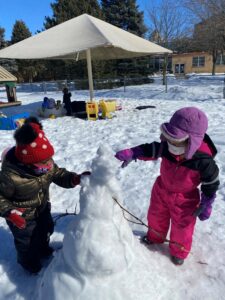
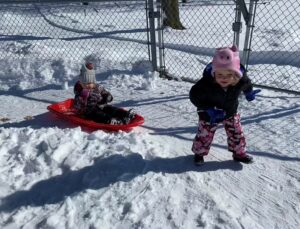
We seem to have turned a corner this week weather-wise. This week felt like a heat wave as the children and teachers took time to appreciate the outdoors every day this week. There was still snow on the ground to provide the children with some sensory experience while getting reacquainted with the great outdoors! Some children have attempted to ride the cars on the playground only to find that they are stuck in the snow. This sparked a conversation about the sun and why we need warm weather (so we can move our playground equipment of course!). The children added some minor details to a snowman that was already made. Every time there is snow on the ground, the children take turns pulling each other on the sleds. We will be going outside as long as the “Real Feel” temp is above 15 degrees. Please make sure your child has all their winter gear at school daily 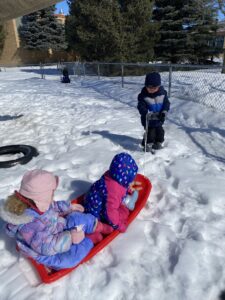
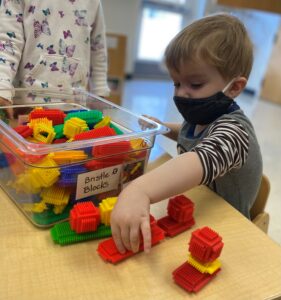
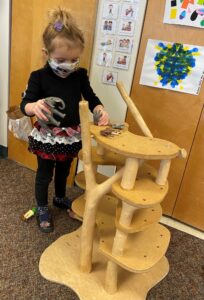
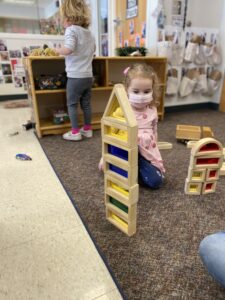
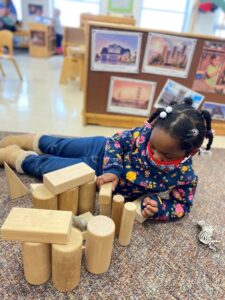
Spending time indoors the past month when it was too cold to go outside has given the children the opportunity to spend longer periods of time using the classroom manipulatives and blocks. The children are beginning to create and label various structures using wood blocks and the Duplos. Sometimes they use props such as trees, animals, cars and people with the blocks. Sometimes they choose to just create towers and other random structures. Both of these experiences provide a creative outlet while exercising spatial awareness and fine motor skills.
We have been spending time working with puzzles of varying difficulty in the classroom. Jigsaw puzzles provide the perfect opportunity to scaffold with children. Scaffolding involves “bridging the gap” between what children can do independently and what they can do with assistance from peers or adults. For example, they might be frustrated that they cannot complete a puzzle. At the table, they get a little help from a friend and together they complete the task. The next day, that same child can complete that same puzzle without assistance. This child may now feel confident enough to attempt an even more challenging puzzle the next time around.
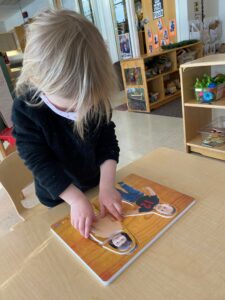
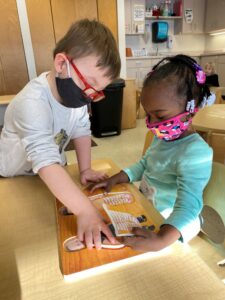
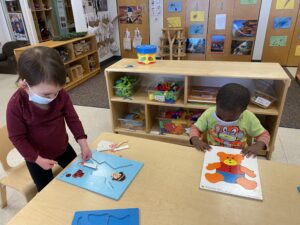
Since we have observed the children become more interested in puzzles and challenge themselves with more difficult ones, we wanted to share some information from https://teach.com/blog/the-benefits-of-puzzles-in-early-childhood-development/ regarding the benefits puzzles provide young children
Physical skills
- Hand-Eye Coordination— your child will develop a keen relationship between what their eyes see, what their hands do and what their brain relates to this information.
- Gross Motor Skills— Larger puzzle pieces and stacking puzzle games can enhance the large movements of your child to the point where they can then work on their fine motor skills.
- Fine Motor Skills— small and precise movements, such as the movement of fingers to get a puzzle piece in exactly the right spot, are built and can lead to better handwriting and typing skills.
Cognitive skills
- Understanding the surrounding world— there is no better way for your child to gain an understanding of the world around them than by letting them literally manipulate the world around them.
- Shape recognition— the first puzzles we use are simple shapes — triangle, squares and circles. From there more complex shapes are used until the abstract jigsaw puzzles are used.
- Memory— Your child has to remember the shape of pieces that don’t fit fir when they will fit later on.
- Problem solving— Either the puzzle piece fits or it does not. Your child uses critical thinking skills to solve the puzzle and, best of all, you can’t cheat a puzzle!
Emotional skills
- Setting goals— The first goal is to solve the puzzle, the next goal will be a series of strategies your child comes up with to solve the puzzle. Such as putting familiar shapes or colors in one pile for future reference.
- Patience— Puzzles are not like sports, you can’t just step up to the plate and swing until you knock it out of the park. You must practice patience and slowly work through the puzzle before you reach the ending.
Let us know if you do puzzles at home and if so, how are the children responding to them?
Stay warm,
Nadine and Kat
