Hey Pre-2 Families!
Wow, can you believe we are already wrapping up the month of February? Fingers crossed that spring is on its way! Unfortunately, we ended this month learning virtually but a big thank you to the children and families that participated during “10:15 with Hill and Xen.” This allowed our class to stay connected and consistent with our learning objectives while revisiting past read alouds and other familiar concepts.
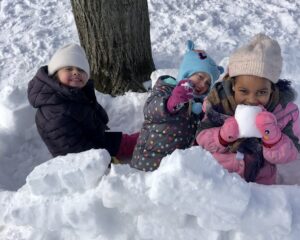
This past month, we continued to dive deep into weather-related activities. Every day during large group, an assigned weather helper, our meteorologist, would look outside and tell us the daily weather. Along with familiar vocabulary such as, sunny, rainy, snowy, windy, and partly cloudy, we added stormy to our bar graph. We briefly touched on lightning or a “flash” in the sky but have yet to experience any stormy weather other than the day-to-day snowfall we have experienced this past month. Going along with storms, we touched on power outages and if any of us had ever experienced one. Reading the story “Blackout,” by John Rocco, gave the children a great visual of seeing how one family experiences a power outage at their home. The television and computer stopped working and the family couldn’t prepare a meal. It was interesting to see how the family turned a negative situation into a positive family experience.
We also introduced and reviewed the word precipitation. We defined it as the way our earth, oceans, lakes, ponds, etc. get water. We reviewed five precipitation concepts being rain, drizzle, snow, sleet, and hail. Drizzle is defined as light rain. Sleet we explained as a mix of snow and ice. Hail we described as heavy ice rocks that can occur in all four seasons. Through daily repetition and review, books, activities, and real-life experiences, the children began conversating about the effects of weather!
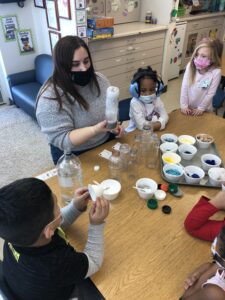
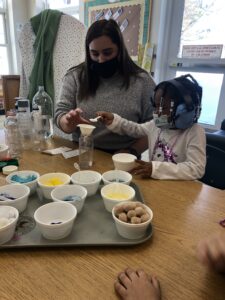
One hands-on experience we found impactful was making weather sensory bottles. Xena found several objects to place in the bottles that represented various forms of precipitation. For example, we used heavy clear gems filled in a plastic bottle of clear glittery water to represent hail. We encouraged the children to shake the bottle to feel and hear how heavy and loud “hail rocks” can be. For partly cloudy, we used cotton balls, white and yellow, along with blue glittery water. We made sure to label each bottle so children could reference them during free play.
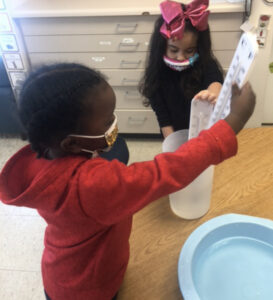
We introduced the use of a thermometer and explained that a weather thermometer is different than the body thermometer used every morning at check-in. Using a bowl of cold water with ice and another bowl of hot water, we allowed the children to explore the use of a thermometer. We asked the children to describe what was happening to the red line on the thermometer. We asked was it moving up or down and why do you think the red line is moving up or down? The children were able to witness temperature change right before their eyes circling back to early concepts of hot and cold.
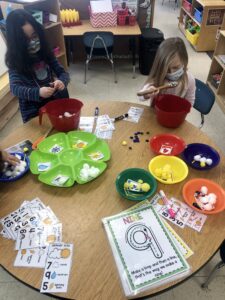
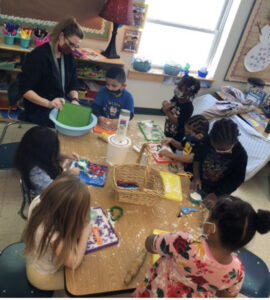
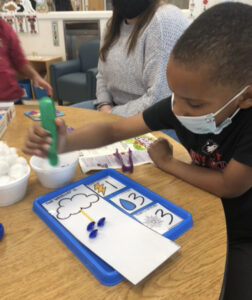
We incorporated weather concepts into daily math activities. Using “weather stew,” the children were asked to choose a recipe card. Following the card, the children were asked to count out how many “lightning bolts,” “raindrops,” or “snowflakes” they would need to complete the recipe. This allowed the children to build quantifying concepts while using familiar items to represent familiar weather vocabulary.
To complete our weather study, Xena and I would like to provide a winter-related experience for the children. We are in the works of finalizing a field trip to the recreation center here on campus to learn, tour, and utilize winter recreational gear. The experts at the recreation center have snowshoes and cross-country skis for the children to try out while physically learning proper techniques on how to use their bodies safely while performing such tasks. More information will be shared regarding this experience.
Looking ahead, Xena and I would like to begin setting further expectations for our classroom. Expectations are what we want all children and adults who contribute to our room to do. By creating expectations, children will expand their moral principles by making personal connections to words they hear frequently. One of the ways we develop expectations are by thinking of the behaviors we ourselves value. During the first week of March, we will be sending home a questionnaire pertaining to behaviors that are most important to your family. Your answers will help guide our discussions and the development of classroom expectations. We will be placing a questionnaire in your child’s cubby space. Please fill out which expectations speak to you and your family. This will be the kick start to our school family’s core values!
As always, if you have any questions pertaining to any of the information above, do not hesitate to ask.
Sincerely,
Hillary and Xena