
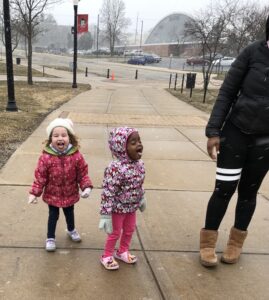
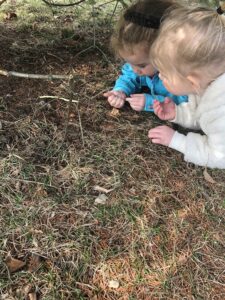
Happy official spring 2s/3s families! The children have observed the seasonal changes happening lately as they comment on the chirping birds we hear on the playground every morning. Kat and I are planning on doing some sunflower planting next week. We found some very simple science books and songs about spring changes and growing sunflowers to share with the children. The children will plant seeds in cups and we will wait so see what happens. The children will be responsible for watering their individual plant while we observe the changes. The sunflower cups will be sent home with the children as soon as they sprout a bit!
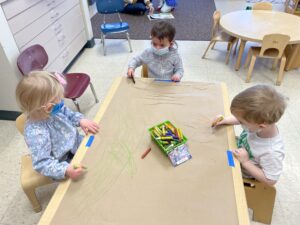
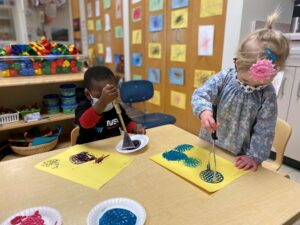
This month we wanted to talk a little bit about the art experiences we do daily in the 2s/3s classroom. Kat and I plan daily process art experiences to meet the needs and interests of the children. Process art allows us and the children the opportunity to think out of the box. We use typical art tools such as crayons, markers, and paint brushes. These tools are the hallmark of the classroom and tools that promote fine motor development and coordination. Sometimes the hands become the preferred “tool” and the art activity turns into a full-on sensory experience!
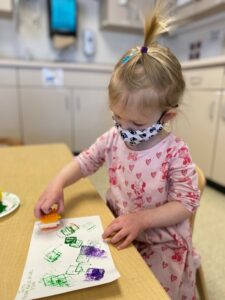
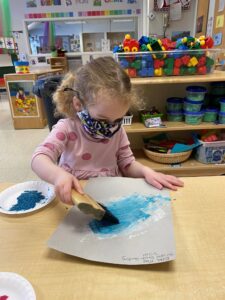
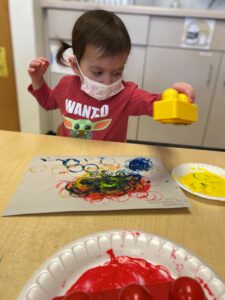
We also have been using different classroom objects to create process art. We use duplos and bristle blocks to build with but they also make some interesting prints when dipped in paint. The children have started to create stories about their art. You may see some dictations on your child’s art when they bring it home. We sit back, observe, and ask open-ended questions while we sit with the children at the art table. Fine motor, language, and cognitive development are all happening at the art table. We hope you have taken the time to check out the ever-evolving art display outside of our classroom.
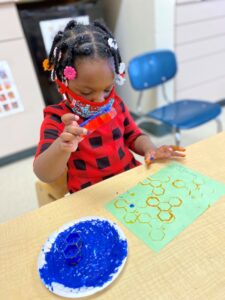
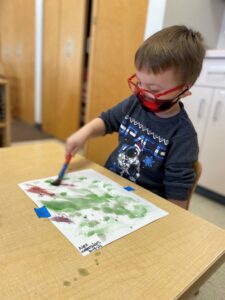
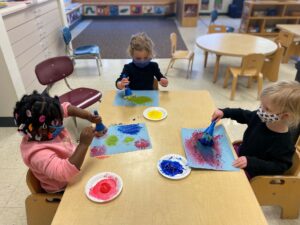
I wanted to share some information on process art with everyone. Do you do any process art at home? If so, please share it with us. Kat and I are always open to new ideas we can share with the children.
https://www.naeyc.org/our-work/families/supporting-development-creativity
Process Art Experiences Support Many Aspects of Children’s Development
Physical Development: Your child’s small motor skills develop as he glues, draws, paints, and plays with clay or homemade dough. Small motor skills are important for future writing.
Language & Literacy Development: As you talk with your child her vocabulary expands when you name new art materials, tools, and concepts such as scissors, collage, purple, wide, sticky, and smooth. Your child often tells you about the ideas she’s expressing through the art and this type of conversation supports literacy development.
Social and Emotional Development: There is joy and self-exploration in self-expression. Art supports the development of self-regulation and self-control as your child focuses, makes choices, and feels successful. The ability to focus is important to future school success.
Children doing process art might say:
- “Can I have more time?”
- “Can I have more paper?
- “Is there any yellow?”
- “I want to make another one”
Parents Can Offer Exploratory Process Art Experiences:
- Provide a place for art materials such as a special bin or drawer
- Save recycled materials (like magazines) children can later use to create collages
- Include watercolor paints, finger paints, and offer brushes and interesting painting tools such as toothbrushes and potato mashers
- Offer many drawing materials like markers, crayons, and colored pencils of different sizes
- Have lots of blank paper (rather than coloring books)
- Include tape, glue, and scissors
- Make homemade dough and offer clay
- Try art outside – use natural materials like leaves in art projects or paint outside for a change of setting
Keep creating, Keep smiling!
Nadine & Kat
