
Dear Families,
We welcome you to our Infant One Newsletter. We strive to keep our families updated with all the recent happenings in our classroom. We hope that you enjoy this monthly newsletter! Let’s start by introducing Kelly as our lead teacher for the month of March! Kelly has been quite busy planning activities that are fun, engaging and educational for your little ones.

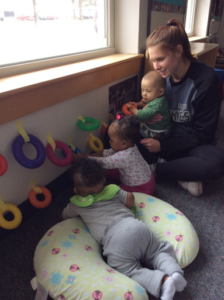
In February, we had the pleasure of having Bailey lead teach. Bailey implemented numerous group times and small group activities that provided the children with opportunities to explore different textures and engage in instruments such as rain sticks, rhythm sticks, bells, cymbals and drums. One of Bailey’s goals was to implement activities that promoted the infant’s physical development. The photo below is an example of one of Bailey’s activities. She attached colorful rings to the wall and encouraged the infants to reach and pull. As you can see, the infants were working very hard at their rings.
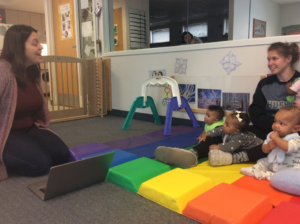
As an assignment, each practicum student must create an activity or event that involves the children’s families, a volunteer community member, or both. This assignment is called Family/Community Involvement. This semester, our first community member volunteer was none other than our very own executive director, Dr. Diane Schael! Diane has sung in a choir for several years. Diane sang a variety of songs in multiple languages! The children were incredibly engaged in her performance. Some even coo-ed along! In the photo, you can see that Aydan, Miya and Zaire are all mesmerized by Diane’s voice.
Lastly, we’d like to share information with you about infant feeding. It is always recommended that you discuss your child’s readiness for solid food and table food with his or her pediatrician. Here is an excerpt and table from the 2019 PDF, “Feeding Infants in the Child and Adult Care Food Program:”
“Early in their first year, babies need your help during a feeding. At around 8 months of age, they begin to learn how to feed themselves. As babies continue to grow, they are able to eat different kinds of foods. Feeding babies the right foods at the right times helps them enjoy new tastes and textures, get the nutrition they need, and avoid choking.” “If you have older babies in your care (about 10 through 12 months) they may be ready to try foods that older children and adults are also eating, known as table foods.”
“Starting solid foods when your child is developmentally ready is important. Your baby is getting bigger and needs more calories and nutrients that can come from solid foods. It gives your baby a chance to try different foods so he or she will like them at an early age and will continue to eat them as he or she gets older.”
The table below can offer some guidance on when to try new foods and what foods are developmentally appropriate.
| Baby’s age | When baby can: | Serve these foods: |
| Birth through 5 months | Only suck and swallow | Liquids Only: • Breastmilk • Iron-fortified infant formula |
| Around 6 months through 8 months | • Draw in upper or lower lip as spoon is removed from mouth • Move tongue up and down • Sit up with support • Swallow soft solid foods without choking • Open the mouth when they see food • Drink from a cup with help, with spilling | Serve liquids above and add solid foods when babies are developmentally ready, including: • Cooked, plain pureed/mashed vegetables • Plain pureed/mashed fruit • Plain pureed/mashed meat and meat alternates (dairy and protein foods): meat, poultry, fish, whole eggs, cheese, yogurt, and cooked dry beans and peas • Iron-fortified infant cereals, bread, small pieces of crackers |
| Around 8 months through 12 months | • Move tongue from side to side • Begin spoon feeding themselves with help • Begin to chew and have some teeth • Begin to hold food and use their fingers to feed themselves • Drink from a cup with help, with less spilling | Serve liquids and foods above, and add: A variety of new solid foods and textures such as: • Fortified ready-to-eat cereal, teething biscuits, crackers, and toasts • Finely chopped vegetables • Finely chopped fruit • Finely chopped meat and meat alternates (dairy and protein foods): meat, poultry, fish, whole eggs, cheese, yogurt, and cooked dry beans and peas |
Thank you for taking the time out of your busy schedule to read our newsletter. We hope you enjoyed it! If you have any suggestions on future topics that you’d like us to discuss, let us know. Have a great March and get out and enjoy this warmer weather!
Sincerely,
Infant One Teacher
